For many years, international higher education has been built around partnerships.
Universities sign agreements, establish exchange programmes, develop joint degrees, launch research collaborations and build strategic relationships with institutions around the world.
These partnerships can be extremely valuable. They open doors, create opportunities and bring institutions together around shared ambitions.
But I increasingly wonder whether the future of international higher education lies not simply in building more partnerships, but in something more fundamental: the ability of universities to become part of — and actively shape — living networks.
This question matters to me not only intellectually, but also because of my own professional experience.
Over more than two decades in international higher education, I have been involved in developing international programmes and partnerships with universities in different countries. I have worked on joint educational programmes in which institutions had to move beyond agreeing to cooperate and learn how to create something meaningful together.
And this is where I began to see an important distinction.
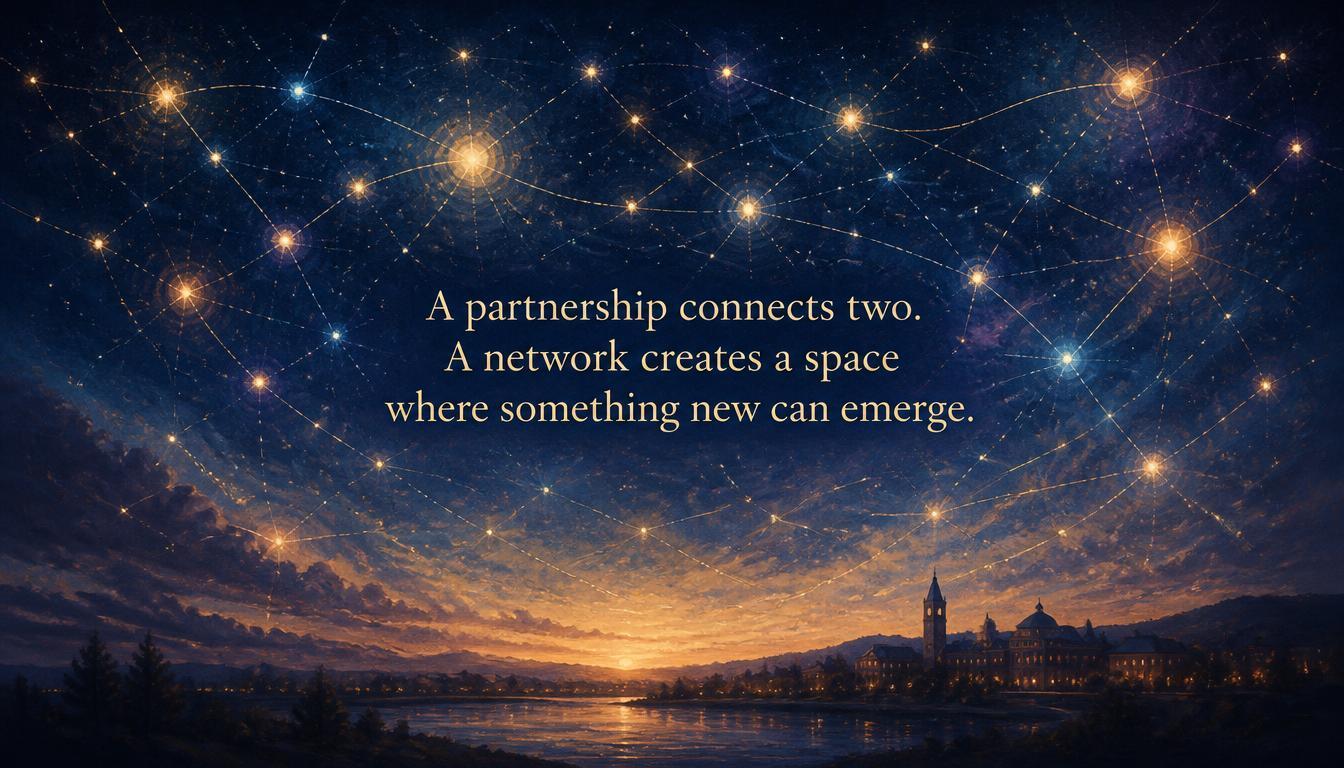
A partnership can connect two institutions.
A network can create a space in which multiple institutions, people, disciplines and communities continuously exchange knowledge, learn from one another and generate possibilities that would not exist within any single institution.
This distinction may become increasingly important for the university of the future.
From bilateral partnerships to living networks
The traditional partnership model is often bilateral:
University A ↔ University B
There is nothing wrong with this model. In many cases, it remains exactly the right one.
But imagine a different configuration:
University A ↔ University B ↔ University C ↔ students ↔ researchers ↔ graduates ↔ industry ↔ communities
Here, the value of the network is no longer simply the sum of individual relationships.
It emerges from the connections between them — from the ways people, knowledge, experience and opportunities move across institutional boundaries.
A student may learn across several institutions.
A research project may bring together universities, companies and local communities.
A graduate may return as a mentor, researcher or co-creator.
A programme may be designed jointly by academics from several countries.
Knowledge generated in one part of the network may transform practice somewhere else.
New relationships may emerge from existing ones, creating opportunities that no single participant could have planned in advance.
The network learns.
And when the network learns, the university learns with it.
Research on university networks points towards the importance of collaboration in addressing complex challenges that exceed the capabilities of any single institution. Yet successful networks depend on more than formal structures or the number of participants. They require mutual trust, reciprocity, openness and a willingness to learn together.
Recent thinking on higher education partnerships likewise places dialogue and co-creation at the heart of relationships capable of generating lasting change.
This is why I believe we need to rethink what we mean by a university partnership.
A partnership should not only ask:
What can we exchange?
It should also ask:
What can we create together that neither of us could create alone?
And perhaps one more question deserves our attention:
What new connections might emerge from what we create together?
Why this matters for the Living University
For me, this is where the idea of the Living University becomes particularly meaningful.
A living university cannot be fully understood as a self-contained institution, operating within its own boundaries and drawing primarily on its internal resources.
It learns through relationships.
It develops through connections.
It responds to its environment.
It brings different forms of knowledge together.
And it continuously creates new relationships through which new possibilities emerge.
In this sense, a network is not simply an external resource for a Living University.
The network is part of the ecosystem through which the university lives, learns and develops.
This perspective shifts our attention from the institution as an isolated organisational structure to the institution as a participant in a wider, evolving system of relationships.
The university does not lose its identity by becoming more connected. Rather, its identity and capabilities can evolve through the relationships it builds, the knowledge it encounters and the contributions it makes to the wider ecosystem.
A living network is not merely a collection of institutions linked by agreements. It is a dynamic environment in which relationships can generate learning, adaptation and possibilities that extend beyond the original purpose of any individual partnership.
And this changes the meaning of internationalisation.
Rethinking internationalisation
Internationalisation is often discussed in terms of measurable activities: how many countries a university is connected to, how many agreements it has signed, how many students participate in exchange programmes, or how many international partnerships it maintains.
These indicators can be useful. But they do not necessarily tell us how deeply an institution is connected to the wider world — or what it learns through those connections.
From the perspective of the Living University, internationalisation becomes a question of how effectively an institution participates in global networks of knowledge, learning and co-creation.
Do its relationships enable knowledge to move across institutional and national boundaries?
Do they bring together different perspectives and forms of expertise?
Do they create opportunities for people to work together on challenges that matter?
And do they help the university change, adapt and develop in response to what it learns?
This is also why I think the future of international partnerships may be less about building ever-larger portfolios of agreements and more about cultivating meaningful, adaptive and generative relationships.
Some partnerships will remain bilateral, and rightly so.
Others may develop into wider networks.
Some networks may be temporary, emerging around a particular challenge and evolving as that challenge changes.
Others may grow into long-term ecosystems of collaboration, learning and innovation.
The important thing is not to replace one model with another, but to understand what each makes possible — and how different forms of connection can work together.
The question may no longer be simply:
How many partners do we have?
It may be:
What becomes possible because we are connected to them?
And perhaps an even deeper question is:
How does being part of these relationships change who we are as a university — and what we are capable of becoming?
From international partnerships to a living ecosystem
These are questions I am increasingly interested in exploring through the idea of the Living University.
If we understand a university as a living, learning and evolving ecosystem, its future depends not only on the knowledge it produces internally, but also on the quality, diversity and generativity of the relationships through which it learns from the world — and helps the world learn with it.
This calls for a different way of thinking about international collaboration: not simply as a portfolio of institutional relationships, but as a living infrastructure for learning, development and collective creation.
It invites us to look beyond the agreements themselves and pay closer attention to what happens between the institutions that sign them.
Because the real potential of international higher education may lie not in how many connections a university establishes, but in what those connections set in motion.
For me, this is where international education becomes much more than internationalisation.
It becomes an infrastructure for a university capable of connecting, learning and continuously creating something new together with others.
#LivingUniversity #InternationalEducation #HigherEducation #UniversityTransformation
