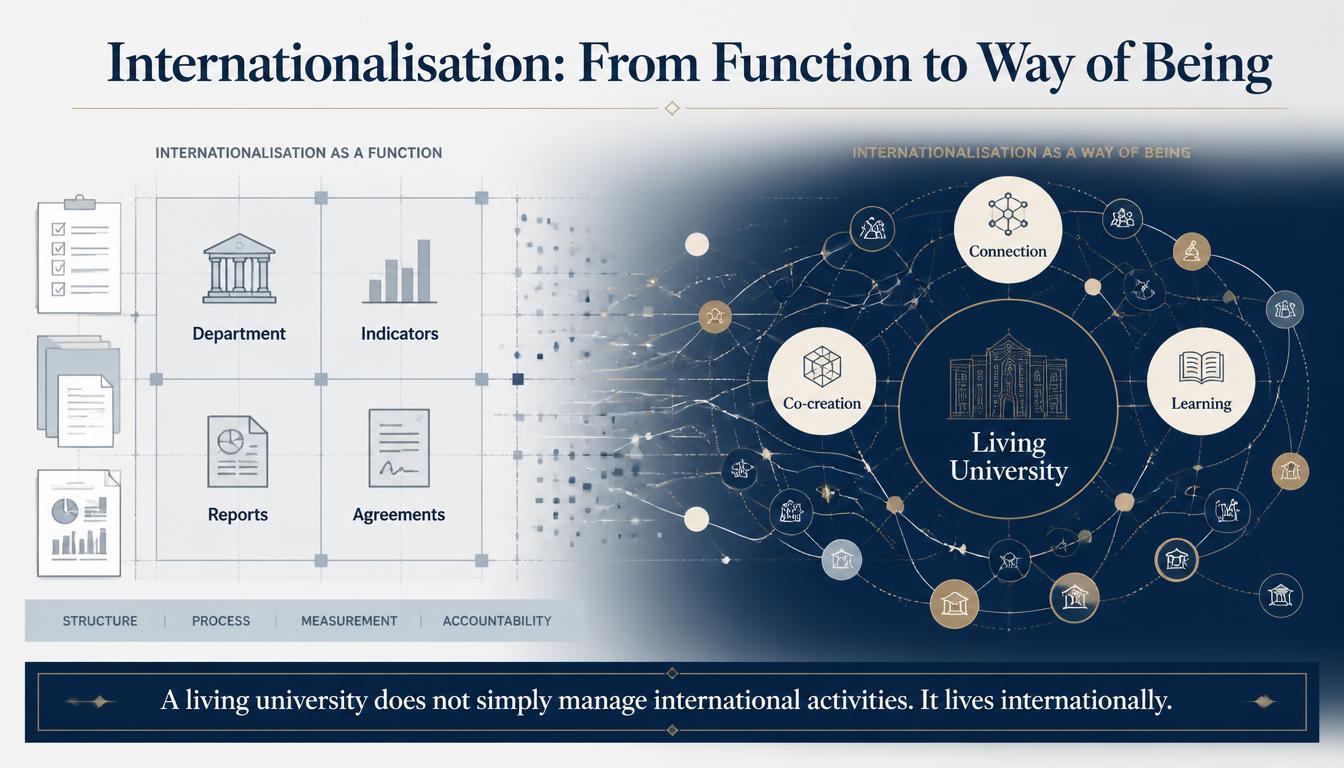
For decades, internationalisation has been organised as something a university does.
It has had its own department, strategy, indicators and institutional responsibilities.
Yet, in many universities, it has remained structurally separate from the core processes through which knowledge is created, teaching is designed, research is conducted and academic communities evolve.
It has had its own department, strategy, indicators and institutional responsibilities.
Yet, in many universities, it has remained structurally separate from the core processes through which knowledge is created, teaching is designed, research is conducted and academic communities evolve.
Over more than two decades in international higher education, I have seen this pattern repeatedly.
Internationalisation is discussed as a separate item on the agenda. Mobility figures become evidence of progress. Agreements accumulate, while their academic potential remains largely unrealised.
Gradually, a distinction emerges between the visibility of international activity and the actual international capacity of a university.
And this distinction matters more than it may first appear.
Because internationalisation is not simply an institutional function to be managed.
It is a quality of the university itself.
In a Living University, internationalisation is embedded in how knowledge is created across cultures and disciplines, how students learn through different academic environments, how research connects to global challenges, and how partnerships generate possibilities that no institution could create alone.
It is not confined to a department, a strategy or a portfolio of activities.
It becomes part of the university's way of thinking, learning and evolving.
This transition, however, raises a deeper institutional challenge.
When internationalisation becomes embedded across the university, its governance can no longer rely exclusively on traditional structures of ownership, coordination and measurement.
The international office does not become irrelevant. Its role becomes more strategic: from managing international activity towards enabling connections, building institutional capacity and shaping the conditions in which international collaboration can transform academic life.
The implications extend further.
Students encounter learning pathways that cross institutional and national boundaries. Faculty engage in more interconnected forms of knowledge creation. Leadership must learn to work with distributed agency, complexity and outcomes that cannot always be captured by conventional indicators.
The university gains new forms of connection — but also new demands on its capacity to coordinate, recognise and learn.
The question, then, is not how much internationalisation a university has.
It is whether international connectedness has become part of its institutional DNA.
And if it has, what does this mean for the way a university is organised, governed and transformed?
The question, then, is not how much internationalisation a university has.
It is whether international connectedness has become part of its institutional DNA.
And if it has, what does this mean for the way a university is organised, governed and transformed?
I am exploring these questions through the idea of the Living University — not as a ready-made model, but as a lens through which to examine what universities may need to become.
Because the next stage of internationalisation may not be defined by the expansion of international activities.
It may be defined by a fundamental change in what a university understands itself to be.
Because the next stage of internationalisation may not be defined by the expansion of international activities.
It may be defined by a fundamental change in what a university understands itself to be.
